How To Remove Orange Rust Stains From Phoenix Concrete
Irrigation rust, battery acid, and hard water staining need chemistry, not pressure. Here is what actually lifts them off a Phoenix slab.
Quick Answer
Orange stains on Phoenix concrete come from iron, not dirt. Sprinkler water carries dissolved iron, desert heat evaporates the water within minutes, and the iron oxidizes into the pores of the slab. Pressure will not lift it. Rust stains need acid based chemical restoration with controlled dwell time and a neutralizing rinse. F9 certified rust removal in Phoenix runs $150 to $500 and up depending on coverage, age, and surface type.
Why Does My Phoenix Driveway Have Orange Stains?
Three sources create most of the orange staining we treat across the Valley.
1. Irrigation overspray
Phoenix groundwater carries a heavy mineral load, iron included. Each time a sprinkler head throws water onto your driveway, walkway, or block wall, that water evaporates within minutes during summer and leaves the mineral behind. Repeat that twice a day through a season and the iron oxidizes into the top layer of concrete. The shape gives it away: irrigation rust forms broad arcs and bands that match the throw pattern of the head.
2. Fertilizer runoff
Granular lawn fertilizer contains iron. Granules bounce onto the sidewalk during spreading, sit through the next watering cycle, and stamp small dark orange dots across the slab. Homeowners notice these a week after feeding the lawn and blame the cleaning company.
3. Metal contact and battery acid
Patio furniture legs, planters, gate hardware, rebar, and golf cart batteries leave rings, streaks, and burn marks. Battery acid causes the worst damage because it etches the surface while it stains, so removal takes the color out and leaves a texture change behind.
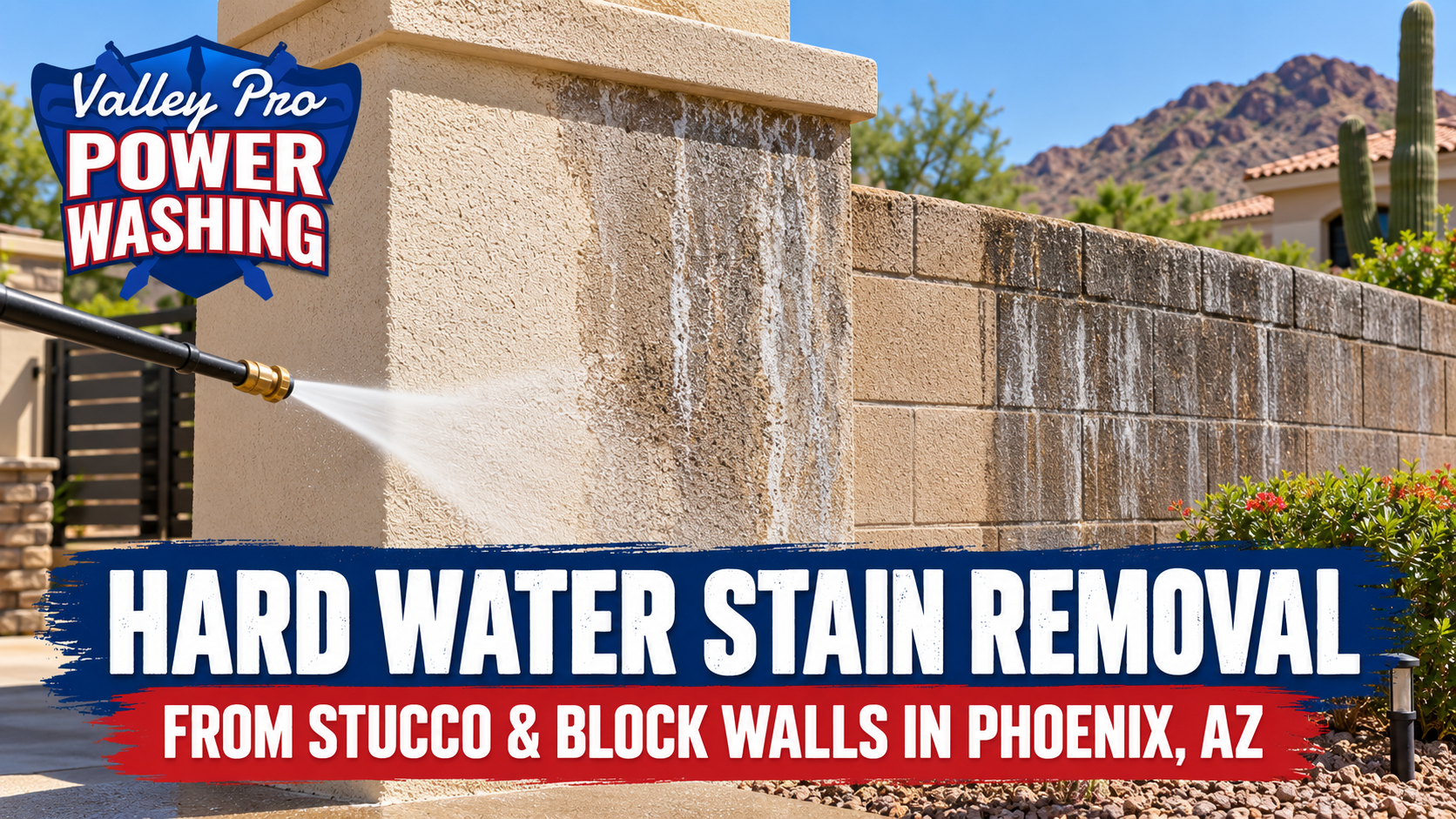
Hard water spotting from the same irrigation source layers on top of all three. That deposit reads white or chalky instead of orange, and it needs different chemistry.
Is It Rust Or Is It Hard Water?
Homeowners treat these as one problem. They are two problems with two different solutions, and Phoenix properties get both from the same sprinkler head.
Rust (iron oxide)
- Reads orange, red, or brown
- Bonds into the pores of the concrete
- Sources: irrigation iron, fertilizer, metal, battery acid
- Needs an acid based reducing agent
- Pressure makes it more visible, never lighter
Hard water scale
- Reads white, gray, or chalky
- Sits as a crust on top of the surface
- Sources: calcium and magnesium in Valley water
- Needs a different acid and a different dwell time
- Common on block walls, glass, and pool decks
Running one product across both wastes chemical and leaves half the problem on the slab. A technician who cannot name which stain sits in front of him will not remove either one.
Will Pressure Washing Remove Rust Stains From Concrete?
No. Pressure washing removes what sits on top of concrete. Rust lives inside it.
We get calls from homeowners who paid for a driveway cleaning and watched the rust get worse. The cause is contrast. A surface cleaner strips the gray film of dust and tire dirt off the slab, the surrounding concrete brightens two shades, and the orange that stayed put now jumps off a lighter background. The stain did not grow. The camouflage came off.
Turning up the pressure to force the issue creates damage you cannot undo. Concrete etches at high PSI. The cement paste between the aggregate blasts out, the slab turns rough, and the newly opened pores absorb the next round of iron faster than the original surface did. That outcome shows up on our schedule most weeks, and it costs more to live with than the stain did.
Rust removal is chemistry work. Pressure plays a supporting role in the rinse and nothing more. Our full method for every surface lives on the Phoenix pressure washing page.
What Is F9 Certification And Why Does It Matter?
F9 is the industry standard product line for restoration cleaning of rust, battery acid, hard water, and irrigation staining. Certification means the applicator trained on which product matches which stain, how to mix it, how long to let it dwell, how to neutralize it, and how to protect the plants, metal, and glass inside the work zone.
Thomas Howard holds F9 certification. That training is the reason we give you a straight answer up front about what will lift and what will not, instead of finding out on your driveway.
Certification matters for a second reason: these products carry real risk. Left without a neutralizing rinse, acid residue keeps working on the slab, corrodes adjacent metal, and burns landscaping. Applied at the wrong dwell time in 110 degree heat, the product flashes off before it reduces the iron and you get a striped result across the surface. Most Phoenix companies that list rust removal on a service page have never trained on any of it.
"We had them back out a second time after my wife's car leaked oil on the driveway and they somehow used power washing magic to make it disappear."
Zachory Smith · Local GuideCan I Remove Rust Stains From Concrete Myself?
You can try the three fixes the internet recommends. Here is what each one does on a Phoenix slab.
Vinegar and salt: too weak
Household vinegar sits near 5 percent acetic acid. It lightens surface tint on a stain that formed last week and does nothing to iron that cured through a summer. The demonstrations that show results run one to three day dwell times, which nobody sustains on an open driveway in August.
Muriatic acid: too strong
Hardware store muriatic etches concrete on contact. It removes the stain by removing the surface holding the stain. The slab turns pale, rough, and porous, and the rust comes back into that damaged surface faster than before. This is the single most expensive DIY mistake we get called out to look at.
Turbo nozzle on a rental machine: creates a second problem
A turbo nozzle concentrates the full output of the machine into a spinning point. It cuts spiral tracks into the slab that no cleaning will remove. The rust stays, and now you have swirl marks on top of it.
The gap between a household acid and a professional reducing agent is the whole job. One dissolves the concrete. The other targets the iron bond and leaves the concrete alone.
How Much Does Rust Stain Removal Cost In Phoenix?
Rust and hard water restoration runs $150 to $500 and up in Phoenix for 2026. Restoration prices separate from standard pressure washing because it is chemical work with material cost and staged application, not a pass with a surface cleaner.
| Service | 2026 Price | Notes |
|---|---|---|
| Rust and hard water stain removal | $150 to $500+ | F9 certified chemical restoration, quoted on inspection |
| Two car driveway pressure washing | $150 to $300 | Surface cleaner plus edge detail and rinse |
| Oil stain treatment add on | $75 to $200 | Old, deep stains lighten but may not vanish |
| Block wall or masonry fence | $150 to $350 | A Phoenix signature surface for irrigation staining |
| Commercial rust removal | Custom quote | F9 restoration on metal and concrete |
Three factors move your number. Age comes first, because a stain from this season releases faster than one baked through four summers. Coverage comes second, since a single furniture ring prices below a driveway carrying forty feet of sprinkler banding. Surface comes third, because pavers, travertine, and colored concrete need lower concentrations and more passes than a gray broom finish.
Text photos to (480) 269-0652 and we tell you what will lift and what will not before you spend a dollar. Every surface we clean is listed in the 2026 Phoenix pressure washing price guide.
How Do I Stop Irrigation Stains From Coming Back?
Removal without a source fix buys you one season. Four steps hold the result.
- Walk your zones. Run each irrigation zone and watch where water lands. Mark every head that throws onto concrete, block wall, or stucco.
- Adjust or swap those heads. Half circle and adjustable nozzles solve most of it for the price of a few parts.
- Water before sunrise. Water that lands at 4 p.m. evaporates on the slab and concentrates the mineral. Water that lands at 4 a.m. soaks in and drains.
- Seal the slab after restoration. A penetrating sealer keeps the next round of minerals sitting on the surface, where a routine wash removes them.
Properties on well water or in areas with heavy iron content benefit from a filter on the irrigation line. If your stains return within months of a clean, the source is still running.
Rust on stucco and block walls follows the same rules with softer chemistry. That work pairs with our soft wash house washing service so the whole exterior matches when we leave.
Rust Stain Removal FAQs
Can every rust stain be removed from concrete?
Most lift to the point where you cannot find them. Stains that sat for years, battery acid that etched the surface, and rust on colored or stamped concrete can leave a shadow. We tell you which category your slab falls into before we start, not after we invoice.
Does rust removal damage concrete?
No, when the product matches the surface and gets neutralized. F9 restoration products target the iron bond rather than the cement paste. Hardware store muriatic acid does damage concrete, which is why we never use it.
Will the rust stains come back after treatment?
Not from the stain we removed. New staining returns if the source keeps running. Adjust the sprinkler heads that spray hard surfaces and seal the slab, and most Phoenix properties stay clear for years.
Can you remove rust from pavers, travertine, and cool deck?
Yes. These surfaces need lower product concentration, shorter dwell, and more passes than gray concrete. Travertine and colored pavers get a test spot in a hidden area first so you see the result before we treat the whole surface.
How long does rust stain removal take?
Most residential rust work adds one to two hours to a driveway cleaning. Heavy irrigation banding across a large slab needs staged application and can run a half day.
Do you remove rust stains from block walls and stucco?
Yes. Block walls and stucco take the heaviest irrigation staining in Phoenix because sprinklers sit right against them. Both surfaces get lower pressure and adjusted chemistry so the finish stays intact.
Send A Photo. Get A Straight Answer.
Free quotes · F9 certified restoration · 125+ five star Google reviews
You might also like
Blog - Valley Pro Power Washing