Hard Water Stain Removal From Stucco & Block Walls in Phoenix, AZ
To remove white sprinkler stains from stucco or a block wall in Phoenix, first stop the sprinkler from hitting the wall, then treat the mineral deposits with a cleaner matched to the surface and rinse at low pressure. The white streaks are calcium and other minerals left behind when irrigation water evaporates in the desert sun. High pressure alone tends to scar painted stucco and porous block before the stain lets go. Valley Pro Power Wash tests a small area first, protects plants and windows, and tells you what can improve before work begins.
- Photo-based estimates available
- Painted stucco and porous block evaluated separately
- Honest expectations before work begins
Serving Phoenix, Scottsdale, Tempe, Mesa, Chandler, and Gilbert
What Causes Hard-Water Stains on Phoenix Stucco and Block Walls?
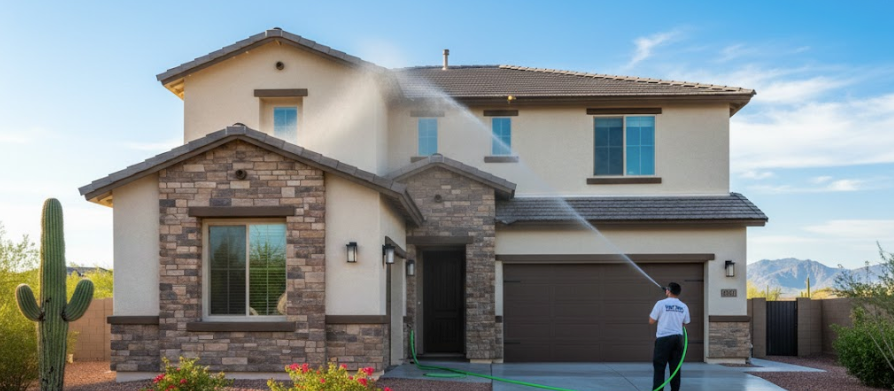
Phoenix irrigation water carries dissolved calcium and other minerals. When a sprinkler sprays a wall and the water evaporates, those minerals stay on the surface as white residue. Repeat that a few times a week for a season and the residue builds into chalky streaks and crusty deposits.
- Repeated overspray. A sprinkler head aimed a few degrees off sends water onto the same patch of wall every cycle, which creates vertical white streaks or a fan-shaped stain.
- Desert heat. Phoenix sun dries the water in minutes and bakes the minerals into the pores of block and the texture of stucco.
- Common hot spots. Entry walls, side yards, pool equipment walls, areas around hose bibs, and any wall next to turf or planter beds.
- The source matters. If the sprinkler keeps hitting the wall after cleaning, new streaks start forming with the next watering cycle.
Fast answer: If stains repeat in the same pattern below a sprinkler head, irrigation overspray is often the cause.
Not sure what you are looking at? Send photos of the stain and the whole wall and we will tell you what we see.
Is It Hard Water, Efflorescence, Rust, Dirt, or Paint Failure?
Several problems look alike on a Phoenix wall, and each one needs a different fix. Identifying the stain before cleaning prevents wasted effort and avoids using the wrong treatment on the surface.
| What you see | Common cause | Can cleaning help? | What may be needed next |
|---|---|---|---|
| Hard-water / mineral deposits | Sprinkler overspray that dries and leaves calcium behind | Often, with a surface-matched treatment and low-pressure rinse | Adjust or redirect the sprinkler heads |
| Efflorescence | Moisture moving through the wall and carrying salts to the face | The white haze can be cleaned, but it can return until the moisture source is corrected | Find and fix the moisture source, such as drainage, grading, or a leak |
| Rust stains | Iron in irrigation water, metal fixtures, gates, or fertilizer | Often, but rust may need a dedicated treatment | A rust-specific treatment and a check of the iron source |
| Desert dust and runoff staining | Dust, monsoon runoff, and splash-back from soil | Yes, in most cases with soft washing | Periodic cleaning and drainage checks |
| Fading, chalking, or failing paint | Sun exposure and an aging coating | No. Cleaning cannot repair a damaged coating | A painter, rather than more cleaning |
A photo review or on-site test area is often the fastest way to identify the stain correctly.
Can Pressure Washing Remove White Mineral Stains From Stucco?
Sometimes, but pressure alone is often not the safest or most effective solution, especially on painted stucco. Mineral deposits bond to the surface. Blasting them hard enough to break that bond can also break the paint, the stucco texture, or the face of the block.
- High pressure can scar, etch, or leave wand marks on textured and painted surfaces.
- The right chemistry and dwell time matter more than PSI for mineral staining.
- Low-pressure rinsing reduces risk around paint, trim, windows, landscaping, and light fixtures.
- A technician should change the method for painted stucco, unpainted stucco, porous CMU block, masonry caps, pavers, and concrete.
- Results depend on stain age, severity, paint condition, and whether the deposits have changed the finish underneath.
Avoid
- Blasting painted stucco at high pressure
- Using harsh products without a test area
- Ignoring active irrigation overspray
- Promising every stain will disappear
Better approach
- Identify the stain type first
- Use a small test area
- Match the treatment to the surface
- Protect plants and nearby finishes
- Set realistic expectations before work begins
How Valley Pro Power Wash Cleans Irrigation Stains Without Damaging the Wall
Our process starts with identifying the surface and the stain, then uses the least aggressive method that does the job. Treatment selection depends on the surface and the stain, so no two walls get the exact same plan.
- Review photos and surface details You text photos of the stain, the full wall, and the area around it. We look at material, paint, and stain pattern.
- Inspect painted vs. unpainted areas Painted stucco, raw stucco, and porous block each react differently, so we sort the wall into zones.
- Identify the likely staining source We check sprinkler heads, drip lines, hose bibs, and drainage so you know what caused the stain.
- Protect landscaping and nearby finishes We pre-wet plants and protect glass, light fixtures, gates, and trim before any treatment goes on.
- Test a small area and apply a surface-matched treatment A test spot shows how the wall responds. A test spot may be necessary before we treat the full area.
- Controlled rinse, final inspection, and prevention tips We rinse at low pressure, walk the wall with you or send photos, and point out the sprinkler fixes that keep it clean.
Heavy or long-standing stains may improve a great deal, but if the deposits have altered the paint or the surface finish, the wall may need repair or repainting to look uniform again.
Trying a light stain yourself
For a small, fresh streak on unpainted block or sealed stucco, a careful homeowner can start with these steps:
- Fix or redirect the sprinkler so the wall stays dry.
- Pick a hidden test spot about the size of your hand.
- Wet the wall and nearby plants with plain water first.
- Apply a mild mix of white vinegar and water, let it sit a few minutes, and work it with a soft nylon brush.
- Rinse with a garden hose and let the spot dry before judging the result.
Stop if the paint softens, lifts, or changes color. Skip wire brushes, muriatic acid, and close-range pressure wand passes, which can etch block and strip paint. If the stain is thick, crusty, or covers a large area, a professional assessment saves time and protects the finish.
What Results Can You Expect?
Results depend on how long the minerals have been there and what condition the surface is in. Here is how most Phoenix walls fall out.
Often improves well
- Light to moderate mineral streaks
- Fresh irrigation residue
- Dust and surface runoff
- Isolated rust spotting, depending on the surface
May improve but needs realistic expectations
- Older deposits baked into porous block
- Repeated sprinkler staining
- Thick, crusty mineral buildup
- Stains on aged or weathered paint
Usually needs repair, paint, or another trade
- Failing or chalking paint
- Etched or permanently discolored finish
- Cracked or loose stucco
- Surface damage unrelated to staining
We will explain what is realistic before beginning work rather than promise a result the surface cannot support.
How to Stop Hard-Water Stains From Returning
The most important step is keeping irrigation water off the wall. These habits keep new mineral streaks from forming:
- Adjust or replace sprinkler heads that spray walls.
- Reduce overspray near stucco, block walls, gates, and windows. Drip irrigation near walls helps.
- Check the irrigation after any landscaping change or sprinkler repair.
- Keep irrigation from running onto painted finishes.
- Schedule periodic cleaning before deposits bake in.
- Treat visible stains early instead of waiting years.
Cleaning addresses the visible residue. Irrigation correction addresses the cause.
Hard-Water Stain Removal for Phoenix HOAs and Property Managers
Community walls take more sprinkler overspray than most homes because common-area turf and shrub beds run right up to them. Valley Pro Power Wash works on:
- Perimeter walls and entry monument walls
- Pool-area walls and ramadas
- Common-area block walls
- Mail kiosk and sidewalk-adjacent walls
- Rental and multifamily exterior surfaces
Photo documentation helps define the scope for a board or management company. Large communities can be cleaned in phases, and off-hours scheduling may be available depending on the property and scope. For a recurring program, cleaning frequency should follow irrigation exposure, surface condition, and visibility, not a one-size-fits-all schedule.
See our HOA exterior cleaning services or review our Phoenix HOA exterior cleaning checklist.
Frequently Asked Questions About Hard-Water Stains on Phoenix Walls
Can hard-water stains be removed from painted stucco?
In many cases, yes. Light to moderate mineral streaks on painted stucco often improve with low-pressure cleaning and a treatment matched to the paint and the deposit. Valley Pro Power Wash tests a small area first, because heavy deposits that have etched or dulled the paint may need touch-up or repainting after cleaning.
Will pressure washing remove sprinkler stains from a block wall?
High pressure by itself rarely removes sprinkler stains from block. Mineral deposits bond to the surface, and porous CMU block can scar if someone tries to blast them off. A controlled treatment with proper dwell time, followed by a low-pressure rinse, does more of the work with less risk to the block and the mortar joints.
What is the difference between hard-water stains and efflorescence?
Hard-water stains come from the outside. Sprinkler water hits the wall, evaporates, and leaves calcium and other minerals on the face. Efflorescence comes from inside the wall. Moisture moving through block or stucco carries salts to the surface, where they dry as a white, powdery haze. Both look white, but efflorescence can keep returning until the moisture source is corrected.
Can you remove white mineral stains without damaging paint?
In most cases, yes, with the right method. A surface-safe approach uses low pressure, a treatment suited to the surface, a test spot before full application, and a thorough rinse. Paint that is already chalking, peeling, or faded can lose more finish during any cleaning, so Valley Pro Power Wash checks paint condition and explains the risk before work begins.
Why do the stains come back after cleaning?
Stains return when the sprinkler that caused them keeps hitting the wall. Cleaning removes the residue on the surface, but each watering cycle deposits new minerals. Adjusting or replacing the sprinkler heads that spray the wall is the step that stops new streaks from forming.
How much does hard-water stain removal cost in Phoenix?
Cost depends on the wall material, square footage, stain severity, wall height and access, the treatment needed, and whether irrigation correction or additional areas are included. Valley Pro Power Wash does not quote a flat price for mineral stain removal without seeing the wall. Text photos of the stain and the full wall to (480) 269-0652 for a same-day quote.
Do you clean HOA walls and commercial properties?
Yes. Valley Pro Power Wash cleans HOA perimeter walls, entry monuments, pool-area walls, mail kiosk areas, and common-area block walls in Phoenix, Scottsdale, Tempe, Mesa, Chandler, and Gilbert. We can document conditions with photos, break large communities into phases, and discuss off-hours scheduling based on the property and scope.
Want a general idea of exterior cleaning costs first? See our 2026 Phoenix pressure washing price guide.
Get an Honest Assessment of Your Phoenix Stucco or Block Wall Stains
Text photos of the wall, the stain, and the surrounding area to Valley Pro Power Wash. We'll review the surface, identify likely causes, explain what can realistically improve, and provide a clear quote for the work.